For my "other" assignment, I chose to attend St. Francis of Assisi Catholic Church in Orem. I also chose to attend the Spanish mass. I hoped this experience would show me what it was like being the "other" in different ways - culturally and religiously. I wanted to get out of my I'm-a-white-native-English-speaker-Mormon-living-in-Utah shell.
Going into this experience I tried to pay super close attention to how I was feeling. Especially, how did I cope with being "the other" and what it would be like to feel like that all the time.
When I woke up Sunday morning, I found I was unusually stressed about what to wear. I made the conscious choice to not wear heels since I'm already naturally tall. I realized I didn't want to allow myself to stand out more than I already would. I also found myself picking clothes that were neutral in color and more likely to blend in. Both of these thoughts had never occurred to me before. I was changing my actions based on what others would think of me. I can see how minorities or outsiders would feel this same way. I can't even imagine a Muslim for example putting on their Hijab and knowing it would further alienate themselves from this western culture. Or more simply, someone changing the way they dress/act in order to fit in, but sacrificing their own culture at the same time.
Once I arrived at the church, I was super nervous about going inside. I sat in the car for a while and once I got the courage to get out, ended up just walking around the church for a couple of minutes. due to nervousness.That's when I took these pictures:
I realized I didn't like putting myself out of my comfort zone when I don't have to. I'm not one to go out of my way to experience/learn about other cultures. I was much more comfortable just walking around. However, I realized that this is what "others" have to do every day. Sometimes something as routine as going to school or riding the bus is out of your comfort zone, but it still has to be done. I rarely have to do this which is probably why it bothered me so much this time.
I realized that one of the most uncomfortable parts so far was the fact that I was alone. Everyone I passed walking to/from the church was with their friends and their family. I kept thinking, "This wouldn't be as bad if my husband were here." And of course that's the ideal, but not very realistic. I may have students who are the only one of their race/religion/whatever else in my class and they will feel the same way I did. A lot of them were also wearing jeans and t-shirts while I was wearing a dress which also contributed to my alienation.
Once I got inside, I felt a little bit better. I realized it wasn't as scary as it seemed. I spent a couple of minutes looking at all of the art on the wall and browsing their gift shop. Although this isn't what takes place in my church, it was still a comfortable place to be. Here's a picture I took:
I didn't take any more pictures once inside the chapel (for obvious reasons).
They started mass with some songs in Spanish which I of course didn't know. This made me realize what was brought up last portfolio when I was asked what about my culture would be bad to have in the classroom. I felt excluded and left out because I didn't know what everyone else was doing/talking about. Likewise, if I'm constantly including white/American pop-culture references in my classroom, I'm sure to exclude many of my students.
The rest of the mass continued on in a similar way. Some singing, some preaching, and some scripture reading. I was okay with most of that part other than feeling lost at some times due to the lack of Spanish/Catholic knowledge. I wished someone would've handed me a hymn book or offered to sit with me so I knew a little better what was going on.
In this case, I did not interact with anyone since that was what everyone else was doing. Everyone seemed to grab a hymn book out of their bag (I wasn't aware that I should have brought one, nor did I even know where to find one). I also realize that I might have been able to sit with someone, but I noticed that each family was sitting together. Since I wasn't there with anyone from my family I felt it inappropriate to go sit with someone else and intrude on their family.
I did notice many similarities between our cultures as well. We both go to church to feel the spirit and get closer to God. We have families who are to noisy and kids who cry during the prayer. Of course we're different, but looking back I think it would've helped me to focus more on these commonalities.
Overall, I did not like being "the other." I would guess that no one really does, but I was surprised how much I was bothered by it. I did not cope with it well. I felt so uncomfortable and that everyone was watching and judging me and wondering "Why is this little white girl here?" I know they probably glanced my way and continued on with their worship and didn't give too much thought to me, but I couldn't help feeling anxious about it the whole time anyway. I like to consider myself a confident, independent woman, but was surprised about how quickly I was shrunk simply by being placed in a different environment.
This helped me realize that if I have students who aren't getting along, aren't participating, or are simply keeping to myself, that they're probably uncomfortable in some way. I need to adapt my teaching/classroom to be more inclusive. I want my students to all know each other's names and to always be sitting by a partner so they can know what's going on if they get lost. I also need to be aware of those who are left out and find a way to include them. This inclusion could be in the form of a friend with a similar background, using examples from their culture, or anything of the sort. I know it would've helped me knowing that someone high up (such as the priest or in the classroom's case, the teacher) acknowledge me and tell me they're glad to have me there. This is what I can do for my students.
According to what we've discussed in class, culture is defined as the shared patterns of behaviors and interactions, cognitive constructs, and affective understanding that are learned through a process of socialization. These shared patterns identify the members of a culture group while also distinguishing those of another group.
Also based off of what we learned in class, the elements of culture include:
1. Values and Beliefs
2. Norms
3. Symbols and Language
When I think of a culture, I think of "What makes it different?" and "What does it consider important?" After pondering and researching this question for a while, I came up with 5 different things I consider important in each culture.
1. Beliefs/Religion
2. Customs and Traditions
3. Language
4. Arts/Literature
5. Social/Political organization
So, since I have a culture of my own, as we all do, I wanted to describe these five aspects and how they relate to my own life:
BELIEFS AND RELIGION:
1.
I am a firm believe of revelation, both modern and ancient. I believe God spoke to prophets in biblical times and he still speaks to them now. The Book of Mormon is a record of just that. I am also adamant that anyone or anything claims to be declaring the word of God (as the Book of Mormon does), it is either true, or a complete lie. There is nothing in between. This clip perfectly describes that. As Tad R. Callister quotes his great-great-grandfather, "That book was either written by God or the devil, and I am going to find out who wrote it [...] The devil could not have written it- it must be from God. It's that simple. This would impact my culture and the way I interact with others around me since I believe in truth and that there's a way to determine if anything is true. Thus, the culture in my classroom would be affected since I would require my students to prove their answer or conjecture is true or come up with a counterexample.
https://www.youtube.com/watch?v=AhaYuXpbLuM
2.
Along with the Book of Mormon, the Atonement of Jesus Christ makes up a major part of my culture. I believe in improvement. I believe in making mistakes and becoming better. Everyone has this opportunity and I'm all about taking advantage of it. It's always possible. No matter how far away we are, it's not too far for God. Holland says this much better than I ever could:
Since this is part of my personal culture, it would impact my classroom since I would allow mistakes to be a prevalent part of my classroom and expect others to do the same. Now, when I'm interacting with others, I would be more patient and allow them the time needed to get to the place they need to be.
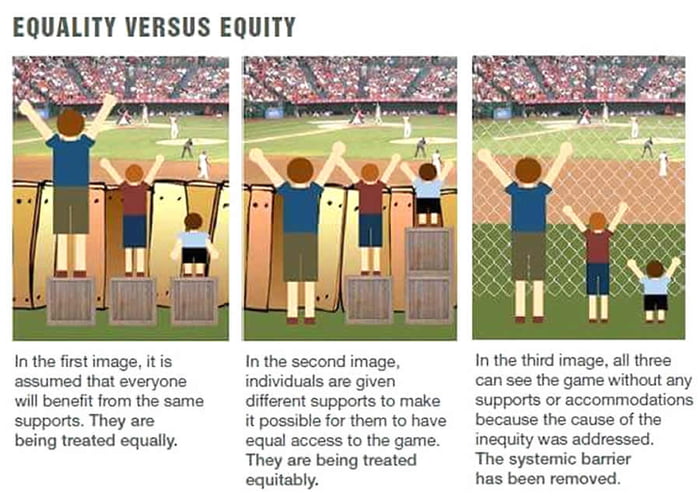
This picture represents everything I stand for. I really can't say it any better than this. We (as a community, school, government, society, everything) focus too much on equality. That's all we talk about! Have we ever tried to removed the barrier in the first place? I've often heard the story of tourists falling off a cliff while trying to see the view better. So, the community officials decided they would have an ambulance always parked at the bottom of the cliff. With an example as simple as this, it makes so much more sense to simply put a fence at the top of the cliff instead of an ambulance at the bottom. We can get back to the root of the problem and fix our problems before more people get hurt.
Since this is part of my personal culture, I would now teach my students (as well as my kids) to focus on fixing the root of any problem instead of addressing it whenever it comes up. For example, instead of telling the school to accompany female students around so they don't get raped, I would now simply teach kids not to rape. This part of my culture causes me to address the root and not simply the result.
4.
I do not agree with a lot of things which are said/done in this country. However, I used to say that I will defend to the death your right to say/do those things. Recently I've thought more about this and changed my mind. I will support and fight for your rights as long as they don't impede the rights of others. As this t-shirt sums up quite nicely, I Defend Human Rights.
I'm a fighter. I fight the new drug- pornography. I've personally seen the affects pornography can have on a family relationship and it's so much more harmful than even the hardest of drugs. I'm a believe that it kills love. It ruins the ability to have a real relationship and I'll adamantly defend that controversial belief.
CUSTOMS AND TRADITIONS
6. On a less serious note, I'm a believer of birthdays. I believe everyone should be celebrated at least one day a year. And that celebration should go all out. Cake, candles, balloons, streamers, presents, the whole shebang. Basically this picture represents me on every one of my friend's birthdays. I like them more than my own.
Since this is a part of my personal culture, it also impacts the culture of my classroom and how I interact with others. Now, I interact with my students realizing that each and every one of them is special. Each of them deserve to be noticed and their ideas deserve to be heard. I take joy in making others feel special and that now impacts how I interact with everyone around me.
7.
Along with birthdays, I love all holidays, but especially Christmas. Each year, my family makes cookie trains like the one below. To me, it represents togetherness. It represents stability. I know that no matter what happens in my life or where the future takes us, I can always rely on the cookie trains to bring us back home. It's one of my favorite things and definitely contributes to my culture.
BOARD GAMES!! I get so overly excited when I talk about board games. At least two times I week we have friends (usually another couple) over to play games. Recently, we love "Smash-Up" but we never get tired of the classic "Settlers of Catan" To me, board games are so much more than games. They're a way to bring people together and have fun. That's definitely part of my culture.
Since this is a part of my culture, it would obviously impact how I interact with others. I know something that brings me joy and I would love to be able to do math revolving around things that I love. Because of this, my classroom culture is greatly impacted. Now, I would allow my students to pick what they would like to do in order to learn a specific topic. I would allow my students to pick their projects, their partners, and their method of learning. I know how important it is to me to be able to do what I'm passionate about and I would want my students to have that same opportunity.
9. Food's a custom right? Well my culture has food as a custom. Namely popcorn. Yes, it's a food and yes I probably eat it every day. My husband received an air popper machine (pictured right) for his birthday and it's the best gift I've ever received :) My husband will say I add way too much salt, but we'll just agree to disagree.
10. English Slang
This one is a little harder to describe. But my culture has its own language. It uses words such as H, Bro, True, and Yeppers and Yeshhhh. H, of course, is short for hell. Like "What the H" or "How in the H did that happen?" Yet somehow it has a more comical connotation than hell. It's funny and mormons aren't as uptight about it. "Bro" and "True" are a little more self-explanatory. I just use they in unusual places. Like "bro" for my mom or husband and "true" after basically anything anybody says that I agree with. Yeppers and Yesh are also pretty obvious, but also contribute to my funny personality. Saying "yes" or "sure" or even "of course" is too commonplace. I enjoy being different and that's part of my culture.
Michael Scott is my inspiration for both yeppers and yesh. as demonstrated by this clip:
https://www.youtube.com/watch?v=oLdFFD8II8U
(Also you can bet money that I say it exactly like that)
Since this is a part of my personal culture, it impacts how I interact with those around me. I tend to use fairly colloquial and casual language which makes me seem more personable and relatable with my students. This may have a negative impact in my classroom when I need to be seen as an authority figure, but I believe that it will create a more open atmosphere in my classroom. This will impact my classroom since my students will feel that they can trust me, since I'm just like them.
11.
After living in Finland for 1.5 years and learning the ins and out of the language, I came to love all of it's little quirks (see the picture below). I frequently (as my husband will attest to) use Finnish words in my every day vocabulary and erroneously assume every one else can understand. It's just part of who I am.
Since I randomly speak Finnish words and my husband is so patient with me, I would have to do the same thing with my students. If they accidentally use a word from another language or if they can explain something better in a different language, I should let them. This impacts how I interact with my students. I need to be patient and allow them to express themselves in whatever way makes the most sense.
12.
There's one more language which contributes to my culture - Spanish. After studying Spanish for 6 years in high school and college and doing a study abroad in Costa Rica, I was sure I would be called on a Spanish speaking mission. When I wasn't, I was determined to not loose this language as part of my culture. Since then, I have returned back to Costa Rica with my Spanish speaking husband. We speak Spanish intermittently at home, and plan on speaking it to our future children as well (along with Finnish of course). I love the food (especially Tapas featured below), the music, the history, the people, and the landscape. Costa Rica, Spanish, and everything else relating to that culture will always be part of my culture.
13.
I am a believer of music, but more than that, I'm a believer in musicals. From Wicked to anything Disney to Phantom of the Opera, I can't get enough. After seeing Wicked on broadway in '09, my life has never been the same. Breaking out into song is something you'll need to understand in order to assimilate fully into my culture.
https://www.youtube.com/watch?v=R4rpG-dipYA
14.
When I was 6, I began taking piano lessons. After being a dumb teenager and quitting in high school, I've since picked it up again. I love sitting down and creating something new that's never been heard before. Music has a way to calm me. Anytime I'm upset, I go play a couple of songs and am instantly relaxed.
As I've realized this, I've realized that this could become a useful way for me to interact with those around me. For example, music is my coping mechanism. However, for other, it could be going for a walk or reading a book. Since I've realized this, I can let my students cope in the way they'd most like. I can allow them to take some time out if needed and be patient if they don't cope in the exact same way I do.
15.
Shortly after piano lessons started, so did the drum lessons. I liked the feeling of being different and standing out for some reason. Most girls don't play the drums so that's what I decided to do. I started with the drum set and branched out into all sorts of percussion. I took lessons, played regularly in my school band, and now just spot light at the occasional ward talent show. I have a drum set just like the one pictured below and it's been one of my most prized possessions. Marching to the beat of your own drum is my culture.
Extracurricular activities and general entertainment can tell you a lot about a culture. For example, my culture consists of a lot of movie-watching. What does that tell you? Well, I like to be entertained. I enjoy a good story line. I love the emotional roller coaster a film can take you on in just two hours. I love learning about other people/place/things that wouldn't otherwise be possible. Currently, I've been loving the late 1990s romantic comedy (examples pictured below). I love the classic boy-meets-girl-and-they-fall-in-love-thing and it'll never get old. I believe that everyone should have a hobby they enjoy and that's important to me and my culture.
Since this is important to me, I realize that it can shape the way I interact with others. If I know how important this hobby is to me, I can value the hobbies of others. In my classroom, this may look like attending the concerts or sporting events of my students. This important pastime of mine allows me to want to understand my students' pastimes.
17.
As referenced earlier, I love The Office. I have seen every single episode at least five times and it never gets old. I constantly have to playing off of my phone or laptop while I get ready, do homework, eat dinner, or just while hanging out. For example, it's currently playing in another window while I work on this assignment. My favorite clip BY FAR which basically invented comedy for me is the following:
https://www.youtube.com/watch?v=9yslB3BkDm8
Comedy, laughter, and John Krasinski are a big part of my culture.
SOCIAL/POLITICAL ORGANIZATION
18.
Back to the more serious issues. Family is one of the most important things in my culture. They are my everything. Spending time with them makes me the happiest. Happiness is an important part of my culture. Pictures are worth a thousand words so I'll let these ones speak for themselves:
Since I cherish families so much, this impacts how I interact with others. I love asking others about their families and want to get to know my students and their families as much as possible. I can call and talk to parents about the positive things their child does in my classroom which can help strengthen their family relationship at home.
19.
Close on the list of important things in my culture are my friends. They make me laugh and have fun and just enjoy myself. Having fun is my culture. Likewise, here are the pictures that can't even begin to describe how lucky I am to have them:
20.
Well, I've saved the worst for last. Like any good culture/country/society, we need some sort of government. However, growing up with a politician as a dad, I saw a different side of politics. I saw the high school side. The dramatic "I'm not going to vote for your bill unless you vote for mine even though it's for the greater good" side. The lobbying and buying out and back-stabbing and fake friends side. I just hated it. I hated seeing my dad act that way and even more I hated the idea that it's probably much worse the higher up you get. Which now brings me to my second point. VOTING. We have the ability to actually elect officials who aren't like this or enact laws that make this all illegal and yet we think our vote doesn't count since we're just one little person living in the very conservative state of Utah. Well, in my culture, WE VOTE! I might go as far to say that it's mandatory. Well, I guess if everyone had my culture, it wouldn't need to be mandatory because everyone would be as passionate about it as I am. So as my last plug, get out and vote. Plus, you get this cool sticker:
In summary, these are all parts of my culture that relate to me. However, I believe each of these things can be stated more generally. My culture is one of mistakes. We mess up, improve, and hold fast to our faith. We have friends and family who are are rocks. We have fun and relax in whatever way suits us best. We enjoy food, languages, and just being ourselves. We celebrate, love, and protect each other. That's my culture.
Since each of these things is extremely important to me, of course it's going to impact how I act and interact with others. I've listed some specifics under some of the pictures above, but mainly I cherish these things and want to help my students develop and cherish their own culture in my classroom.
More importantly though is how this culture can help me in my future classroom. I want my classroom to be a very open setting. We can make mistakes, improve, laugh, have fun, and be ourselves. We can each march to the beat of our own drum. Every culture/background is welcome and hopefully contributes to our learning. Most importantly, everyone can succeed in my classroom. Whether that is done by eliminating barriers (real or abstract) or by providing additional assistance, everyone is on the same level and is treated that way. My classroom is a safe place. I will defend each student's right to be in my classroom as long as it doesn't impede the learning of others. This is my classroom culture.
After analyzing my culture, I thought about how might it help or hinder my future classroom.
How it could potentially help:
It emphasizes having a way to express yourself which is important in having a strong relationship with your students.
It focuses on equity and making sure each student has the right and opportunity to a good education.
It emphasizes that making mistakes and failing is okay. This would help students explore new ideas and not be afraid of being wrong.
How to could potentially hinder:
It involves a lot of pop culture references whether that be in the form of music or books or games and could potentially exclude students not familiar with them.
It focuses a lot on birthdays/holidays which would exclude those children whose families/cultures don't celebrate them.
It can be narrow minded in its assumption that students having loving/happy families who will support them.
It involves Spanish, Finnish, and English, but disregards the other languages/cultures. This could potentially lead to bias or unintentional discrimination against them.